
Neural Decoder for Behavioral Choice
Decoding left vs. right choices from Neuropixels population activity (Steinmetz 2019) with PCA, logistic regression, and permutation testing.
- Organization
- Independent · Steinmetz / DANDI 000017
- Timeline
- 2025
- My role
- End-to-end analysis: firing-rate features, PCA, decoder, null tests, and figures.
The problem
Neuropixels recordings give hundreds of simultaneously recorded neurons — noisy, correlated, and high-dimensional. The question: can left vs right choice still be decoded above chance from a short post-stimulus window, without pretending the decoder is a causal circuit map?
Why it matters
Shows whether behaviorally relevant structure lives in a low-dimensional neural subspace. Cross-validation alone is not enough; a permutation null asks whether the effect beats chance label structure.
Data & inputs
- Steinmetz et al. 2019 — Mouse Richards session from DANDI 000017.
- 778 neurons × trial firing rates in a 0–300 ms post-stimulus window.
- 174 left/right choice trials after filtering for analyzable behavioral outcomes.
Approach
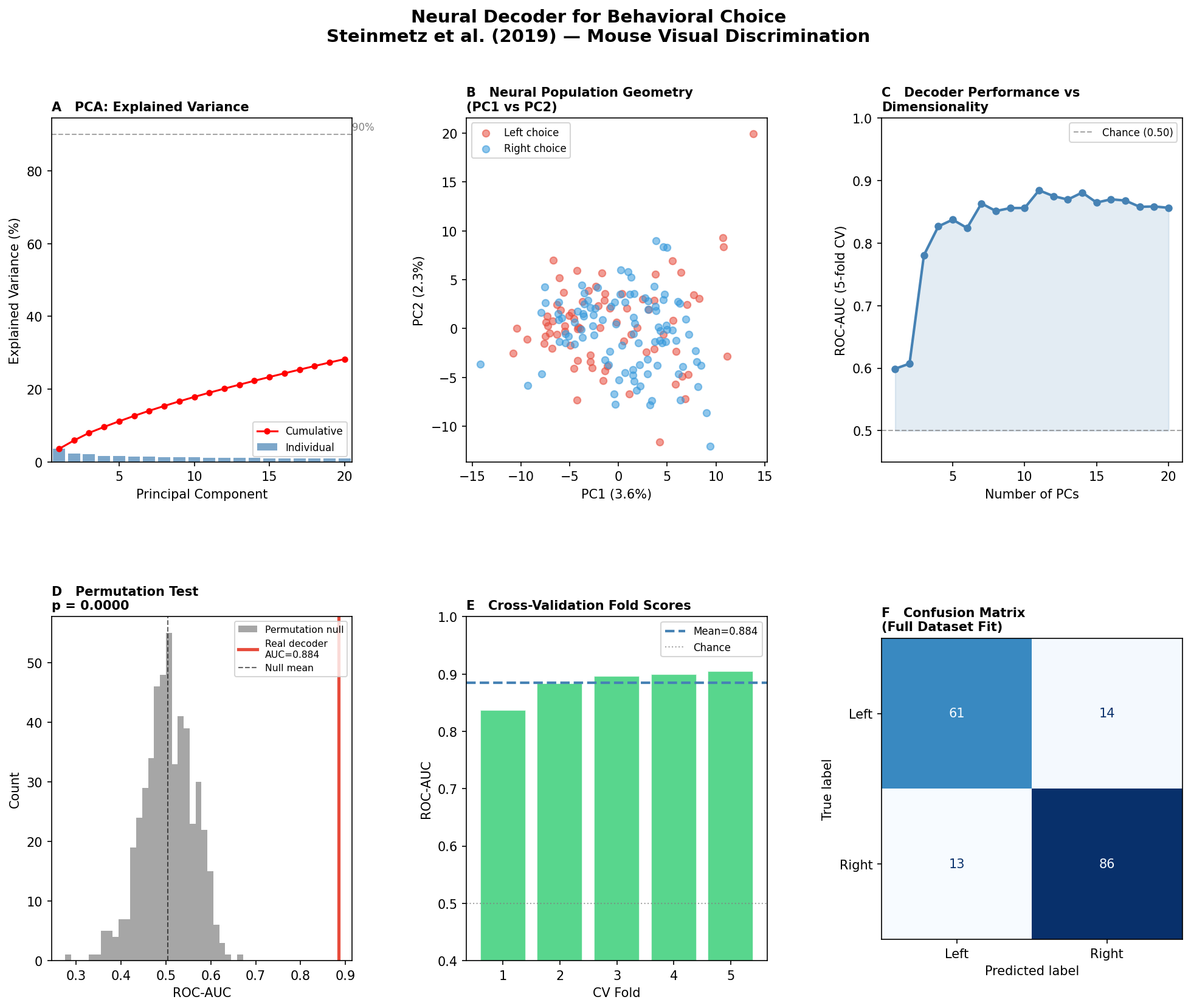
Build a trial × neuron firing-rate matrix → PCA to compress correlated population activity → L2-regularized logistic regression on the top principal components → 5-fold cross-validated ROC-AUC, plus a 500-shuffle label-permutation null to estimate chance.
- 01Firing rates174 trials × 778 neurons
- 02PCALow-dimensional neural modes
- 03DecodeL2 logistic regression
- 04ValidateCV + 500× permutation null
My contribution
- Implemented the full decoding pipeline from firing-rate features through figures.
- Chose PCA + L2 logistic regression to control overfitting with 778 features and only 174 trials.
- Ran a 500-iteration label permutation test so “above chance” is quantified, not assumed.
- Swept principal-component count and showed performance saturates around ~11 PCs.
Technical details
- Primary metric: ROC-AUC for ranking left vs right trials (reported with fold mean ± std).
- Secondary metric: classification accuracy under the same CV splits.
- Null distribution mean AUC ≈ 0.505 — confirms the chance baseline sits at ~0.50.
- Regularization and dimensionality reduction are required; raw-rate decoding overfits in this regime.
Challenges & decisions
- p ≫ n features vs trials — without PCA, the classifier memorizes noise.
- Population correlations mean many neurons carry overlapping information; the useful subspace is smaller than 778.
- Decoding choice is not the same as identifying a specific causal circuit.
Results
- ROC-AUC 0.884 ± 0.025; accuracy 0.799 ± 0.039 under 5-fold CV.
- Permutation p-value < 0.0001 versus the label-shuffled null (mean null AUC ≈ 0.505).
- Decoder performance saturates near ~11 principal components — most usable signal lives in a compact subspace.
Limitations
What I learned
Cross-validation measures stability; permutation testing asks whether the effect beats chance. Both belong in a decoding write-up.